
Technology that supports muscles and joints
"Add more leg!"
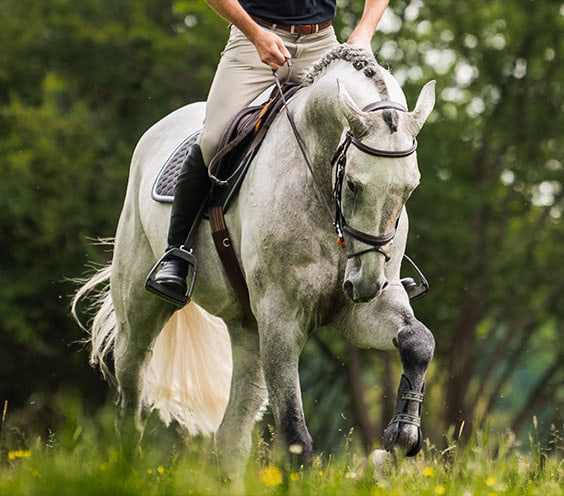
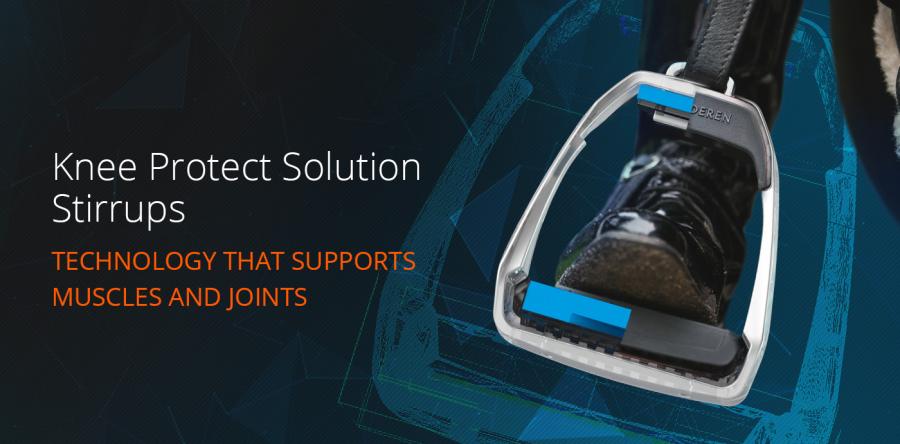
Each of us has heard these words from the trainer many times. There is nothing surprising about it - after all, legs are key riding aids. However, while fulfilling their function, they are subjected to enormous loads while riding. Dr. Sheila Schils, in her scientific research "Biomechanics of Jumping", calculated that during landing after a jump of 120 cm height, the leading leg on which the horse lands is loaded with a force of approx. 2 tons. A large part of this energy is transferred to the rider who absorbs it while landing "on the stirrup". The situation is similar during dressage work. While posting the trot or in a light seat, the entire body weight rests completely on the stirrups. Knowing that horse riding is a unique discipline in which the legs are subjected continuously to enormous, unnatural overloads, we have created Knee Protect Solution stirrups. Its unique double kinetic energy absorbers system significantly reduces the load on the knees and ankles while riding.
The first step in understanding the problem, or "no hoof, no horse"
The adult human skeleton consists of 206 bones, and 26 of them are just in one foot! Not only does this intricate structure of joints, ligaments, and muscles keep the body upright, but also maintains dynamic balance in motion. Sensitive receptors located in the soles register changes. Then, by tensing individual parts of the muscles, they adjust the foot movements and, as a result, change the position of the entire body. It is their proper functioning that prevents damage to the structures located above - ankles, knees, hips, and back. Achieving a natural and relaxed position in the saddle, thus ensuring comfort for the horse, depends to a large extent on the proper feet positioning and stable support in the stirrups. During training, the bodyweight rests on the metatarsal bones, which, together with the springy ankles and knee joints, absorb most of the vibrations and overloads which are affecting the rider.
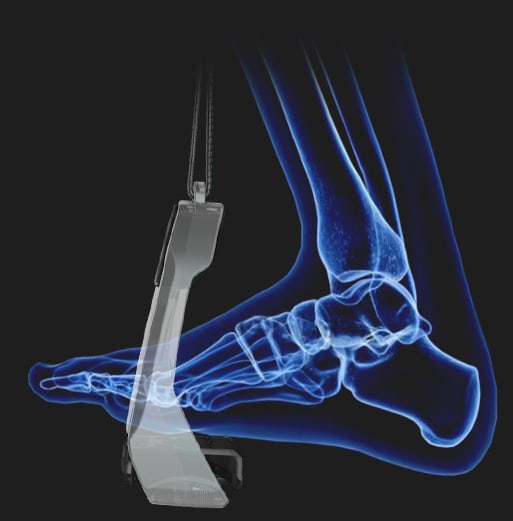
Correct posture is determined by the mechanical longitudinal axis of the entire lower limb, which means that the ankle, knee, and hip joints should be positioned in a vertical line. The correct structure of this system is a solid foundation and thus a starting point for each training and all physical activity. The arrangement of the joints along the longitudinal axis distributes the force acting on the body between the joints. The correct rider's position in the saddle necessitates adopting a physiologically incorrect position of the lower limb, which may lead to its overloading. If the forces acting on the rider are not evenly distributed over all joints, one of the elements of the kinematic chain is getting overloaded, e.g., in the foot, knee, hip, or spine. This process can lead to microtraumas that will accumulate over time, resulting in irreversible changes in the joints.
Physiotherapist Łukasz Ślusarczyk - Graduate of the University of Physical Education in Warsaw. Currently a second-year student of osteopathy at the Polish Academy of Osteopathy OSTEON. He specializes in working with athletes and patients with orthopedic injuries. Official Polish Equestrian Federation physiotherapist in the 2019 season.
Technology that supports rider’s muscles and joints
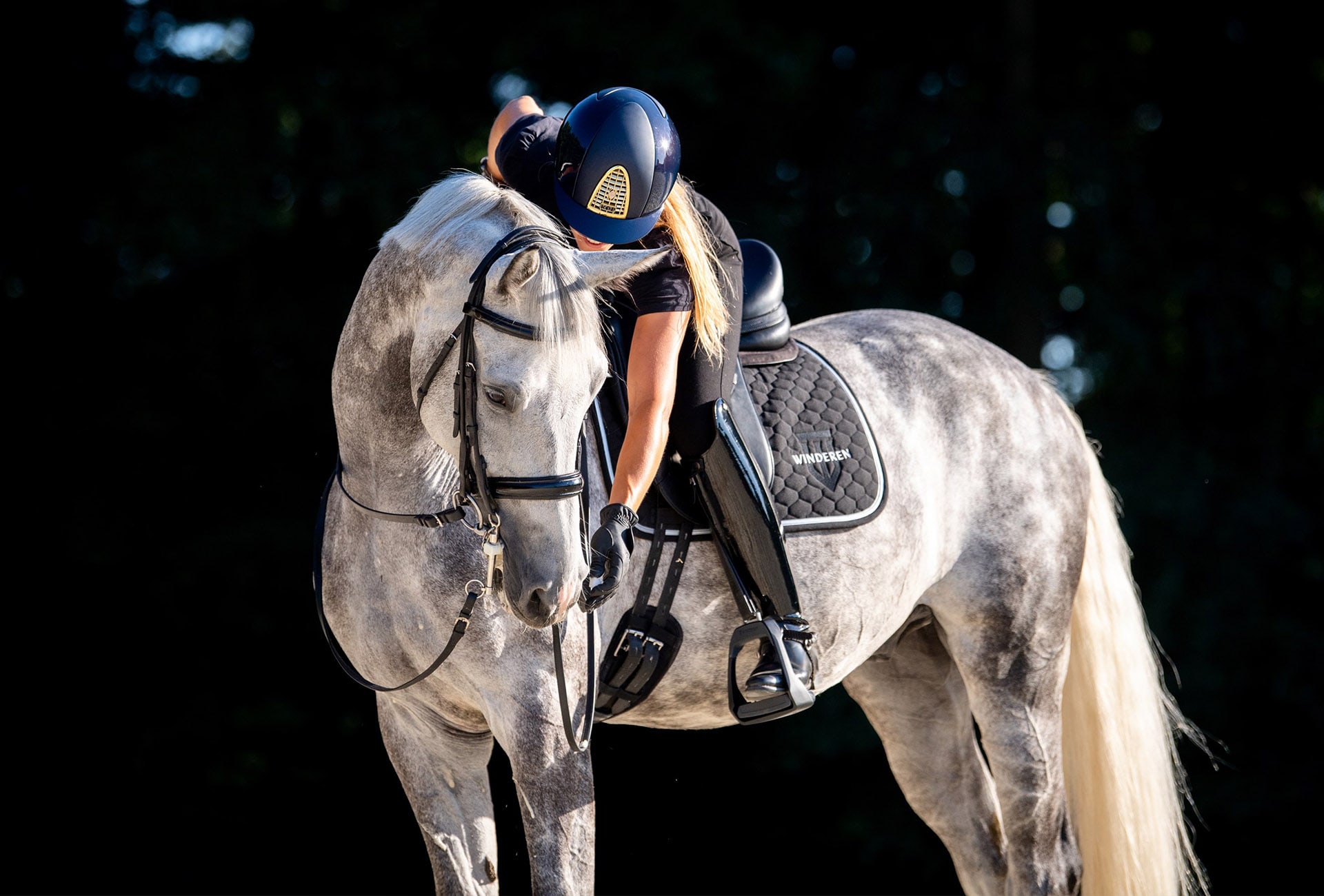
Riders rarely pay attention to the amount of work that is done not only by the horse’s legs, but also their own ones. Athletes practicing other sports have been supporting their bodies by choosing proper, shock-absorbing footwear for years. Choosing the right equipment results in higher training comfort, which translates into better results and fewer injuries in the long run. In the case of horse riding, the stirrups should fulfill the shock-absorbing functions because the foot rests on them continuously throughout the training.
„The correct rider's posture is easier to achieve if the feet in the stirrups are stable. Each deflection of the center of gravity during horse riding causes a loss of balance and a reflex reaction of the neuromuscular system, aimed at returning to the optimal positioning of the body. The energy spent on maintaining a stable position while riding causes excessive muscle tension and results in their fatigue. A tired muscle shows delayed neuromuscular control, which makes it less protected from injury while riding. The muscles maintaining the rider's position increase the compressive forces acting on the joints and cause faster wear of the articular cartilage. Therefore, it is worth investing in equipment that will help you maintain an optimal position while riding without excessive work on the part of the muscular system, reducing the risk of direct and overload injuries.” – Physiotherapist Łukasz Ślusarczyk
Winderen Knee Protect Solution - stirrups for everyone
Riders, regardless of age, gender, or the number of horses ridden per day, will see muscle and joint soreness over time as an integral and normal part of their training. However, it is not a necessary element of horse riding, but a problem for which we managed to find a solution. Winderen Knee Protect Solution stirrups, which debuted on the market in mid-2018, are constantly collecting very positive opinions.